

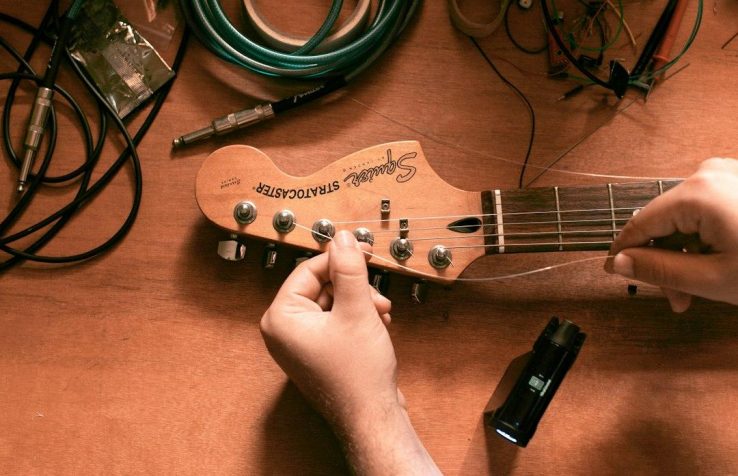
How to Cut Guitar Strings Cleanly – and Why They Keep Wrecking Your Wire Cutters
You finish a restring, reach for the cutters to trim the tails at the tuning posts, and the cut ends come off ragged: burred, sharp stubs where you wanted a flush, clean cut.
Then you look at the jaws: another shiny notch, one more chip in blades that were already dented from the last set of strings. If every string change ends this way, the cutters are usually the problem, not your technique.
Why guitar strings wreck ordinary cutters

The steel in a guitar string is music wire, far harder than the soft copper and electrical wire that cheap household cutters are ground to cut. Close a soft-wire blade on it and sooner or later the blade chips and dents where it bites the string, leaving a notch in the edge.
You notice the damage on the very next string. The blades no longer meet flush; they pinch and roll the string instead of shearing it, so the end comes off crushed and flared, not clean. Once the edge carries a few notches, every cut takes more squeeze from your hand and leaves a rougher end.
A clean shear matters most on wound strings. A plain string (your high E and B, and usually the G) is a single strand, and even a mediocre cut leaves a fairly tidy end. A wound string (the low E, A and D) is wire wrapped around a core, and a crushing cut breaks the wrap open so the end splays and starts to unravel. A clean shear keeps the wrap tight right up to the cut.
What actually cuts music wire cleanly

To cut steel guitar strings cleanly, you need a cutter rated for hard wire, not scissors, nail clippers or household soft-wire cutters. Hard-wire blades are hardened to shear music wire without chipping, so the string parts in one firm squeeze and the end comes off clean, with no crushed flare.
Music shops sell dedicated string cutters for this job. Electronic flush cutters also make a tidy job of plain strings, but most are made for soft copper wire and struggle with a heavy wound string. A side cutter rated for hard wire handles the whole set, and the same pair will cut picture-hanging wire, spring steel and other hard wire around the house or studio. If you only restring once or twice a year, the small cutter built into many string winders is enough.
Scissors and nail clippers are the usual stand-ins, and neither cuts a steel string cleanly. Scissors are made for paper and cloth, so a steel string wedges in the pivot and dents the blades. Nail clippers crush more than they cut and leave a splayed end on a wound string. Both tools end up damaged.
Check the stated capacity before you trust any cutter with your heaviest string. Makers that publish ratings quote a wire type and a diameter in the product specs: hard wire or piano wire, up to a stated number of millimeters. String gauges are quoted in inches, so convert them before you compare: a .010 plain E is about 0.25 mm of steel, and a .056 low E is about 1.4 mm across, with a thinner steel core inside the wrap. A bass .105 measures about 2.7 mm over its wrap, again with a thinner core at its center, so check the stated rating against your set before you cut.
For cutting guitar strings cleanly, a pair of Maun side cutters for hard wire (model 4950-160) is a good choice. Their blades are case-hardened to HRC 57, and they are rated to cut piano wire up to 2.0 mm thick. Piano wire is the same hard steel that guitar strings are made from, so that rating comfortably covers every string in a standard electric or acoustic set, where the heaviest is about 1.4 mm. The handles give you 23 times the force you put into them, so even a wound low E parts in one clean squeeze instead of being chewed through. They cost more than a basic string cutter, but a basic cutter rarely tells you what it can cut.
The restring cutting routine

The order matters: slacken the old string before you cut it, bring the new one up to pitch, and trim the tail last.
- Slacken a string before you cut it anywhere along its playing length. A string at pitch is holding real tension; cut it there and both ends snap loose at once, toward your fingers and across the headstock. Detune to slack first.
- Cut the slack old string once, near the middle. With no tension on it, one cut in the middle drops both halves, and you unwind them off the post and the bridge by hand.
- Wind on the new string, stretch it, and tune up to pitch. Tune, stretch the string with your hand, retune, and repeat until it settles.
- Only now, trim the tail at the post. The tail past the tuning post carries no tension, so it is safe to cut with the string at pitch. Take it off close to the post in one clean shear.
- Leave a few millimeters of tail, or cut flush. A short tail gives you something to grip at the next change and a little insurance if a wind ever slips, but it stands near the headstock as a sharp point. Flush looks tidy and keeps cut ends away from your fingers, but it leaves no margin and it is the hardest cut to make cleanly, right against the post. Pick one and stay consistent across the instrument.
Keeping cut ends safe

Bend the cut ends down against the headstock with the jaws of your cutters, or cut them flush; either way, nothing sharp is left to catch cloth or skin. A crushed cut end is sharp enough to snag a gig-bag lining or nick a fingertip, and a splayed wound end catches on whatever touches it. A sheared cut end comes away clean, sits tight to the post, and bends down without opening the wrap.
FAQ
What is the best tool to cut guitar strings?
A cutter rated for hard wire, or a dedicated string cutter for standard gauges. Hardened blades shear music wire without chipping, so the cut end comes off clean. Match any cutter’s stated capacity to your heaviest string, especially on bass.
Can I cut guitar strings without wire cutters?
For steel strings, not well. Scissors wedge and dent on a guitar string; nail clippers crush the end and splay the wrap on a wound string, and both come away damaged. Nylon classical strings are the exception: ordinary scissors cut those cleanly.
Should you cut your guitar strings after restringing?
Yes: trim the tail at the post once the new string is wound, stretched, and tuned to pitch, not before. Leave a few millimeters if you want something to grip, or cut flush for a tidy headstock. Either way, wait until the string is holding pitch before you trim.