

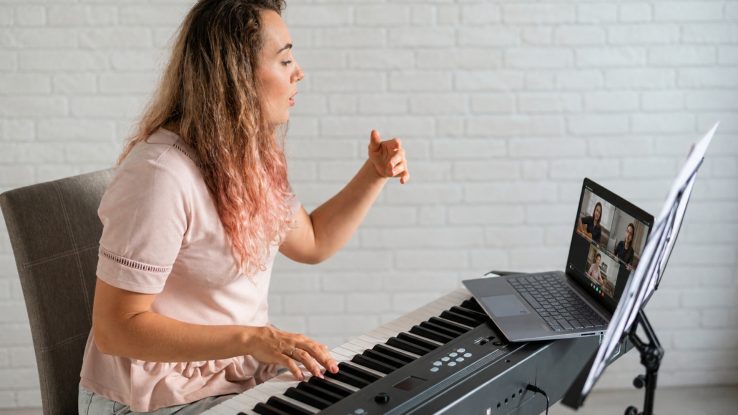
Remote Music Collaboration: Working With Artists Worldwide
Working with artists worldwide has always sounded romantic. Until recently, however, there was no possibility to work with a world-class violinist from Japan or an experienced producer from Europe if you couldn’t afford moving there or simply didn’t have such an opportunity. Now, collaboration with a musician located in Seoul while you’re working in Stockholm has become completely possible and, what’s more, usual. The world of remote music collaboration has already gone far beyond experiments to become routine practice in the field.
Sure, remote work allows musicians to collaborate in a convenient way. But besides convenience, it gives more opportunities to those who are ready to use them. Working with artists worldwide means access to a wider variety of talent, understanding of various production styles, and building a professional network that truly includes representatives of the global music industry. However, the process requires certain preparation. This article is devoted to the mechanics of remote work for musicians, standard tools, and ways of implementing it.
Shift to Remote Collaboration in the Music Industry
Five years ago, remote collaboration was a secondary option, something that was considered only in case of inability to do anything else. The pandemic forced people to collaborate remotely on a large scale, and what happened surprised everyone. People understood that the quality of their creations could be even higher when they worked remotely. There are two reasons: first, people stop worrying about being present in the studio and can concentrate only on creating music; second, people have more time for their creative decisions, while session musicians have time to make several takes without paying for studio rental.
Now, it has become possible to collaborate without much trouble because the infrastructure has developed rapidly. The quality of video calls in 2015 is unacceptable nowadays due to the development of compression technologies, bandwidth improvements, and the creation of specialized collaboration software. Moreover, according to reports from session musicians, remote collaboration even increases their income, as they can participate in various gigs all around the world rather than only local ones. Producers state that remote work gives them an opportunity to work with the best musicians from all over the world.
It does not mean that remote work is the same as in-person collaboration. On the contrary, there are some differences that have an impact on both the creative and technical sides of the process. However, these differences do not make remote collaboration worse. They give people new possibilities.
How Remote Music Sessions Actually Look in 2026
Let’s imagine a situation where a producer and a session musician decide to collaborate despite the difference in their geographical locations. Let’s see what a typical remote music session looks like in 2026.
The producer sends the musician stems and a click track, usually using a file transfer service. At the moment, producers and musicians do not use amateur equipment but services created for transferring audio files that should be checked and archived. The musician performs their work in their home studio or rented space, listening to the click and reference mix through headphones while recording their instrument into an audio interface. They can perform several takes and send all of them to the producer. The producer can listen to the takes almost immediately, usually within a few hours after recording.
Communication between people involved in collaboration takes place through different channels. For fast communication, there is direct messaging, while for detailed feedback, musicians often use recordings of voice memos rather than typing messages. Of course, people can discuss details of their work in a video call; however, musicians state that such situations appear rarely because collaboration is mostly asynchronous. Someone records their work, sends the file, then another person listens to it and sends feedback, and so on.
Here is the list of systems that make remote collaboration possible:
- Solid internet connection with fast upload speed (at least 25 Mbps in order to send audio files comfortably)
- Professional audio interface and studio monitors on both ends in order to avoid misunderstanding caused by cheap speakers
- File management systems that help organize versions and avoid confusion with several “final” folders
The main thing that strikes people when they start collaborating remotely is that a lot of attention should be paid to the workflow. One should be ready to have backup systems in case the bandwidth does not work, establish certain naming conventions in order not to confuse “Vocal Take 3” and “Vocal Take 3 Revised,” and manage time zones in order not to bother someone in Tokyo at 3 AM. All of that is done in order to avoid problems and leave room for creativity.
Building Trust During Remote Collaboration
One of the things that is not discussed in remote work articles is the question of trust. It is built very easily when one works in person – people see how others perform their work, hear the decisions being made, and understand that everyone is listening to the music carefully. Remote collaboration gives much less opportunity for this, so people should find another way to build trust.
Professional musicians find this easier because they are explicit about what they deliver. A session musician from Los Angeles will send detailed information about their equipment, the number of takes performed, and the reasons why they selected the best take. A producer will give a more detailed description of their vision for the music in notes because there is no possibility to show it using only the demo of the track. It turns out to be useful because everything is documented and the proof is saved in the project files.
Reliability in terms of deadlines and revisions is the other factor that helps people work remotely successfully. Remote collaboration works perfectly when people take their obligations seriously, return revisions in three days as promised, and send three takes in five days as agreed. It helps people build their reputations because the majority of people working in the global music industry collaborate remotely.
How to Protect Your Files and Connection During Remote Sessions
Nowadays, when one’s music exists in the form of files that transfer across borders multiple times per week, security is not paranoid thinking but professionalism. People send their unreleased songs to collaborators located in other countries, and their work has value. Moreover, people share personal studio details and sometimes personal addresses while organizing sessions. In this case, secure practices become a part of one’s workflow rather than a separate issue.
The majority of professional musicians collaborating remotely use private file transfer systems rather than public cloud storage. Passwords are managed properly. In cases of sensitive sessions, some producers and musicians even create temporary accounts that expire after the end of the project. People use encrypted messaging platforms in order to communicate about project details. These measures are not excessive. They are normal practice in the global industry where intellectual property is important.
Another aspect that needs to be managed is the route of transferring files. Musicians and producers who work regularly with their international colleagues using unreleased material often think about protecting their internet connection more carefully. When one is transferring a demo that was never published before or downloading stems from an artist who has not announced their collaboration, one needs protection for their connection, especially when people work from cafes and shared places from time to time.
Many musicians find that it is possible to purchase online services that provide encrypted connections. This solution is useful for protecting collaborations from leaks and making sure that the connection is safe while uploading and downloading files regardless of their location.
For this reason, some remote collaborators choose to buy online VPN services to add an extra layer of protection when working with sensitive files over public or unfamiliar networks.
Tools That Matter for Remote Collaboration
The software side of remote music collaboration has developed greatly. There is no universal solution because different workflows need different software. For example, a mixing engineer can use one solution for receiving raw tracks from session musicians worldwide and another solution for collaborative mixing with another producer.
For file transfer, professional solutions like Splice, Dropbox Pro, and Treehouse have become standard because they provide version control along with storage. One should not only save files but manage their versions. It becomes especially important when someone asks, “Was that the version with the doubled vocals?” and one has to reference something from two weeks ago.
As far as communication is concerned, many creators use various tools. Slack is used for quick updates, Discord for real-time collaboration, and email for communication about contracts and important details. Moreover, some people use project management tools like Notion and Asana for tracking revisions.
As far as actual recording and monitoring during sessions are concerned, musicians and producers use different platforms. Some people use Zoom or Google Meet for the video call and local recording through an audio interface. Some prefer specialized solutions like Source Connect.
Creating the Creative Connection
Of course, technical aspects are very important, but they are not the most interesting ones. The creative connection that takes place remotely works best when people forget about distance. It may seem strange, but it works.
Some of the best remote collaborations take place between people who have never met in person but have established a creative connection during the collaboration. The violinist hears the arrangement and plays something that makes the producer rethink the whole track. The producer sends the revised mix, and the session musician understands that it means the part should be played differently. This exchange is the actual collaboration, and it is often more effective without casual conversation.
In order to establish this kind of connection, people should be generous in giving feedback and be open to the influence of other people. One should not be afraid of trying something new and changing their mind. One should believe in the skills of other people and let them make decisions in their own sphere. A great session musician does not want anyone to tell them how to hold the bow, while a great engineer does not want anyone to prescribe which compressor to use. However, both want to understand the emotions one wants to transmit and the problems one tries to solve.
Practical Steps Towards Remote Collaboration
If someone decides to collaborate with other musicians or producers but has not tried it yet, the best thing to do is to start small. One should choose a musician or producer whom they want to work with regardless of geographical location, agree on a certain project, and go through one complete cycle: sending stems, receiving feedback, sending revisions, and listening to the final product.
In order to learn something, one should try it. It is better to experience collaboration than simply read about it. One will realize which tools suit them, which communication style works best for them, and how the creative process changes when they work remotely.
Conclusion
The remote music world has become active, accessible, and rich with talented people. Geographical barriers that divided musicians before are gone now. Only the work matters: good ideas, skills, willingness to collaborate, and proper systems that make everything work. It has always been this way in the world of great music. Technology has simply changed geography.
The musicians and producers making the most interesting works right now are not restricted by the cities they live in. Neither should you be. Just start wherever you are and with whatever tools you have, and collaborate with people who make your music better. Everything else will follow naturally.